Kellyjo Coney-Khan seated beside white orchids

For capable adults and parents ready for decisive, lasting change

Evidence-Based Psychotherapy and Counselling, with Advanced-EMDR Intensives designed for people who want to work through the experiences that still shape how they feel and respond today.

THE APPROACH

Working together over three or five days

Advanced Psychotherapy · EMDR Intensives · Private 3–5 Days

A structured, powerful process for those who carry a great deal of responsibility and want to feel more at ease in themselves, less quick to react and more present with the people they love.

FOR CAPABLE ADULTS AND PARENTS

You understand it. It still happens.

For capable adults and parents whose reactions don't match what they know, especially under pressure. Ethical, structured advanced EMDR and psychotherapy for stress and trauma in Singapore, delivered over a few days, with support afterwards so the change holds.

Take the 3-minute trigger profile Book a discovery call

IS THIS YOU?

You've done the reading. You may have done therapy or coaching. You can explain where your patterns come from, and you handle a great deal well on the outside. Yet under pressure, the old reaction still takes over, and it often shows up with the people who matter most to you, including your children.

Why do you react the same way even when you know better? Under stress, the body's stress response acts before the thinking mind can.

  • Repeating the same reactions with partners, children, family and colleagues
  • Losing your footing under pressure, when emotional triggers take over
  • Shutting down, going numb or withdrawing when conflict or stress rises
  • Knowing exactly what to do, then struggling to do it in the moment

That gap isn't a lack of insight or effort. What you know isn't available in that moment, and that's what the sessions address.

WHAT'S UNDERNEATH THE REACTION

A reaction like this isn't random. It's made of four parts that work together, and I address all four.

What you feel in your body.

A tight chest, a clenched jaw, a drop in the stomach, a sudden heat or going blank. The body reacts before the thinking mind does, so this is often where it starts, and where we begin.

The belief underneath.

Something like "I'm not enough," "I'm not safe," "it's my fault," or "I have to keep control." You may not say it out loud, but it's running quietly in the background, and it shapes how you read every difficult moment.

The memories that formed it.

Usually earlier experiences, often from childhood or past relationships, where that belief and body response first made sense. The present situation sets off the old one.

The pattern you use to cope.

Criticising, withdrawing, people-pleasing, over-controlling, going numb, staying busy. These patterns once protected you. They're not flaws, but they often cost you now, in your relationships and in how you feel.

Insight alone doesn't change this, because it works at the level of the mind. The process needs to reach the body, the belief and the memory, and then give you somewhere to practise the new response.

WHAT I DO DIFFERENTLY

I don't diagnose you or give you a label to live with. I look for the root of the reaction, and focus directly on the memories, beliefs and body responses underneath it.

The techniques I use

At Tidylodge in East Singapore, I use advanced EMDR, which means training beyond the standard course:

  • Advanced EMDR protocols and the Flash Technique
  • Polyvagal-informed nervous system regulation
  • Attachment and parts-based approaches, including Internal Family Systems (IFS)
  • Ongoing clinical supervision

The EMDR intensive is structured and evidence-based. It runs over a number of days instead of months of weekly sessions, with a plan built around your own triggers, patterns, emotions, beliefs and memories.

HOW IT WORKS

  1. A conversation first. We talk through what's happening and whether this is the right fit. If it isn't, I'll tell you.
  2. Mapping. Before any processing, I map your history, your triggers, the body sensations that come with them, the beliefs behind them and the memories they connect to, so the sessions are aimed at what matters most to you and your goals.
  3. Focused sessions. We reprocess those memories and the reactions attached to them, until the charge comes down and the old response has less hold over you.
  4. Integration. We practise the new responses in the situations where you tend to revert, so it holds in daily life and not just in the room.

Some people prefer a concentrated format over a few days. Others do better with a year of processing and integration sessions. We decide together which suits you.

You don't need to tell me everything for this to work, and you can keep your eyes closed throughout if you prefer.

For individuals who understand themselves, yet still don’t respond how they want under pressure. You may think clearly, reflect deeply, and function at a high level, yet in the moments that matter, something else takes over.

This is structured, multi-day work designed to change patterns at the level they were formed, so your system no longer overrides you.

Delivered through Advanced-EMDR and trauma-informed psychotherapy.

Learn More…

For individuals operating at a high level who find that, despite their capability, their responses don’t align under pressure.

This focused, multi-day intensive is designed to stabilize internal responses, improve clarity in decision-making, and allow consistent performance without the system overriding you.

Learn More

THE QUESTIONS PEOPLE ASK ME

Why do I react the same way even though I know what to do?

Because understanding happens in the thinking mind, and the reaction starts in the body. Under stress, the body responds first, and what you know isn't available in that moment. It isn't a lack of effort or a flaw in you.

Why do I snap at my children and feel awful afterwards?

Most parents who ask this care deeply, which is why the guilt hurts so much. Often a child's tone, crying or defiance touches something much older, and the reaction arrives before you've had a chance to choose. It can change, and it starts with understanding what is being set off, not with trying harder.

I've done therapy and coaching. Why hasn't it changed anything?

Both can build insight and skills, and many people benefit from them. When a reaction is tied to earlier experiences, insight and skills often don't hold under pressure, because the trigger sets off the old response first. That's the point where working with the body response, the belief and the memory underneath can help.

Is it a memory problem?

No. You haven't forgotten what you learned. When a trigger fires, the stress response takes over, and the tools you know aren't available in that moment. The aim is to bring the charge down, so they become easier to reach when it matters.

Do I need to talk about everything?

No. You don't need to tell me everything for this to work, and you can keep your eyes closed throughout if you prefer. We go at a pace that feels manageable for you.

Do I need to have had a traumatic childhood?

No. Many people who come to me describe a perfectly "fine" upbringing. What matters is whether an old experience, big or small, is still setting off a reaction in the present.

BEFORE YOU DECIDE

How do I find a therapist I can trust in Singapore?

There's no single "best therapist in Singapore." You can check my qualifications, but they can't tell you how it will feel to talk to me. That's what the first conversation is for. Tell me a little about what brought you here, ask how I'd work with you, and decide for yourself whether you'd like to meet again.

Isn't it a big investment?

It is, and it's worth weighing carefully. The three-day intensive is $10,500 and the one-year integration programme is $13,000. Both can be paid in four instalments over four months. It helps to compare that with what another year of the same pattern costs in your relationships, parenting, sleep and work, and with what weekly sessions would add up to over the same stretch.

I've done EMDR or therapy before and it faded. Why would this be different?

Processing can reduce the charge a memory carries, but it doesn't automatically make a new response your default under pressure. That usually needs structured integration, where we review what happened in real situations and practise the new response. It's why the programme includes integration sessions, and why some people choose the year format.

Should I choose the three-day intensive or the year?

The three-day intensive suits people who want focused, concentrated processing. The year programme suits people who want more gradual change, with processing and integration sessions spread out so the new responses have time to settle. We decide together in our first conversation, and it's fine to start with one and add the other later.

What if it brings up too much?

That's a fair worry, and the pacing is built around it. Before any processing, we map your history, triggers and strengths, and we go only at a pace your system can manage. You stay in control throughout and can slow or stop at any point.

See all questions

ABOUT

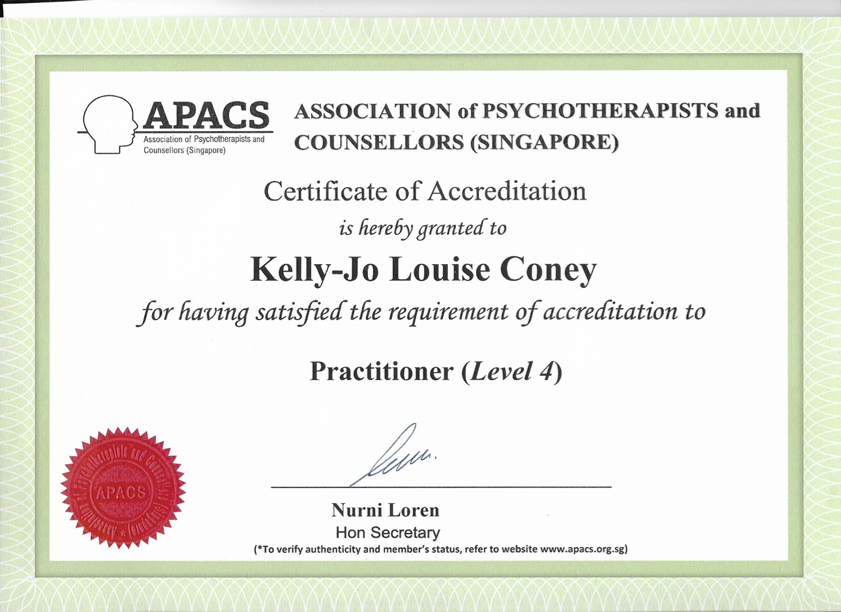
I'm Kellyjo Coney-Khan, a registered integrative psychotherapist and counsellor based in East Singapore. I've spent thousands of hours in treatment rooms, and my practice focuses on one thing: helping capable people respond differently when it matters.

I trained in EMDR with practitioners who were themselves trained directly by its creator, Dr Francine Shapiro, and I've continued my training and supervision with leading figures in the field. I'm certified and trained in Advanced-Protocol EMDR, the Advanced EMDR Flash Technique, and attachment, trauma and parts-based work. I keep my practice small so every client receives my full attention.

Trained and supervised by

I trained in EMDR with two practitioners who were trained directly by Dr Francine Shapiro, the creator of EMDR, who died in 2019:

  • Sigmund Burzynski: Trained in EMDR by Francine Shapiro in 1992
  • Dr Laurel Parnell: Trained by Francine Shapiro, and creator of Attachment-Focused EMDR

My training and supervision also includes:

  • Dr Roger Solomon: Advanced-Masters level training, who aided the US Senate, NASA, Secret Service, and FBI with EMDR
  • Mark Brayne: Supervisor Mark Brayne, Creator of Attachment-Informed EMDR
  • Dr Robert Rhoton: Founder of the Arizona Trauma Institute and CEO of the Trauma Institute International

Testimonials

Clients often describe this work as something they didn’t expect, not because it’s unfamiliar, but because the change is immediate and sustained.

Paradise Lost,

“The mind is its own place, and in itself can make a heaven of hell, a hell of heaven.”

WHERE TO START

Not sure if this is for you? The 3-minute trigger profile gives you a clearer picture of your patterns, and there's no commitment.

Take the trigger profile

Ready to talk? Book a discovery call. We'll go through what's going on and decide together whether to work together.

Tidylodge is a private, high-intensity psychotherapy practice, accepting only 2 Clients per month

Scroll to Top